
Discovery through Partnership | Excellence through Quality

Properties
| Storage Buffer | 50mM Tris/HCl, pH 7.5, 0.15M NaCl and 10% glycerol |
| Storage Temperature | -20ºC |
| Shipping Temperature | Blue Ice or 4ºC |
| Purification | Affinity Purified |
| Cite This Product | Human Recombinant HSP70 Protein (StressMarq Biosciences | Victoria, BC CANADA | Catalog# SPR-103) |
| Certificate of Analysis | This product has been certified >90% pure using SDS-PAGE analysis. The protein has ATPase activity at the time of manufacture of 3.3µM phosphate liberated/hr/µg protein in a 200µl reaction at 37°C (pH7.5) in the presence of 20ul of 1mM ATP using a Malachite Green assay. |
Biological Description
| Alternative Names | HSPA1A, HSPA1B, HSPA1, HSP70, HSP70-1, HSP70.1, HSP70-2, HSP72, HSP73, HSX70, Heat shock 70 kDa protein 1A, Heat shock 70 kDa protein 1B |
| Research Areas | Cancer, Heat Shock |
| Cellular Localization | Cytoplasm |
| Accession Number | NM_005345 |
| Gene ID | 3303 |
| Swiss Prot | P0DMV8/P0DMV9 |
| Scientific Background |
HSP70 is a highly inducible molecular chaperone that plays a pivotal role in protein quality control across all major cellular compartments. In the brain, HSP70 is essential for preventing the aggregation of misfolded proteins, a key pathological feature of neurodegenerative diseases. HSP70 binds to nascent and partially folded polypeptides, stabilizing them and facilitating proper folding or directing them toward degradation pathways. This function is particularly critical in conditions such as Alzheimer’s, Parkinson’s, and ALS, where protein aggregation and impaired proteostasis drive neuronal dysfunction and cell death. The chaperone activity of HSP70 is regulated by ATP binding and hydrolysis, which triggers conformational changes that control substrate binding and release. Its ability to recognize hydrophobic regions of unfolded proteins enables it to suppress aggregation and promote cellular recovery from stress. Therapeutic strategies aimed at enhancing HSP70 expression or activity are under investigation for their potential to reduce neurotoxicity, improve protein clearance, and slow disease progression in neurodegenerative disorders. |
| References |
1. Zho J. (1998) Cell. 94: 471-480. 2. Boorstein, W. R., Ziegelhoffer, T. & Craig, E. A. (1993) J. Mol. Evol. 38(1): 1-17. 3. Rothman J. (1989) Cell. 59: 591 -601. 4. DeLuca-Flaherty et al. (1990) Cell. 62: 875-887. 5. Bork P., Sander C. & Valencia A. (1992) Proc. Natl Acad. Sci. USA. 89: 7290-7294. 6. Fink A.L. (1999) Physiol. Rev. 79: 425-449. 7. Smith D.F., et al., (1993) Mol. Cell. Biol. 13(2): 869-876. 8. Prapapanich V., et al., (1996) Mol. Cell. Biol. 16(11): 6200-6207. 9. Fernandez-Funez et al., (2000) Nature. 408(6808): 101-106. |
Product Images
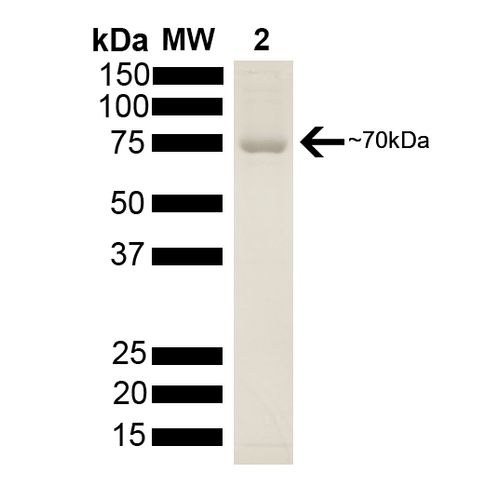
SDS-PAGE of 70kDa Hsp70 protein (SPR-103).
 Powered by Bioz
StressMarq Biosciences :
Based on validation through cited publications.